
Alexander Karlsson
Deus Ex Machina: The New Kid on the Block
A new kid on the block? From Clawdbot to an autonomous AI Ops business led by a lobster CEO.

I got nerdsniped. Again.
Like many of you, I spent the last week watching headlines fly by about a new toy for AI fanatics: Clawdbot. Or Moltbot. Or, as it finally chose to be called, Openclaw.
It’s marketed as what Siri was always supposed to be. A proactive assistant that doesn’t just wait for you to ask for a timer, but actually lives inside your apps, your calendars, and your life.
It’s not a security issue, it’s a feature. (Mostly kidding)
I saw the demos. People giving their assistants a real voice via ElevenLabs, giving them phone numbers to call and book appointments on their behalf, or letting them organize an entire chaotic mailbox while you sleep. I saw it giving daily morning debriefs and weather reports.
I am, of course, easily nerdsniped. My partner has officially asked me to stop talking about AI at the dinner table at this point.
The Security Tightening
Before we go further, let's talk about the elephant in the room: security. Giving an LLM-based agent full access to your digital life is a terrifying prospect and quite frankly lunacy.
Prompt injection is a real threat, and without serious security practices, you're basically leaving your digital front door wide open. I had to spend a significant amount of time tightening the infrastructure to ensure my assistant could operate without becoming a liability.
So I did what any sane person would do: I gave Clawd Gustaf a playground with real teeth, but inside a heavily fortified perimeter.
Bootstrapping the Playground
I bootstrapped the infrastructure on a dedicated VPS and handled the memory and context management myself.
Instead of a black-box database, we’re using an Obsidian Vault as the primary memory store. For search and retrieval, I integrated qmd. Interestingly, during testing, Clawd Gustaf himself compared his internal local model to qmd and concluded that qmd was way more efficient for searching his long-term memory.
This setup effectively solves the "goldfish memory" problem that plagues current AI agents. He doesn't just remember what we did yesterday, he can pull context from meetings, design decisions, and code changes from two weeks ago or longer with ease.
The playground consists of:
- A GitHub organization for the codebase.
- Cloudflare access for domain management and edge deployment.
- A Bankr wallet funded with $100.
- Dedicated email account.
I also decided to strip back the guardrails. I didn’t want him asking for permission every time he made a decision. I told him to explore, search, and make up his own mind. If he found something he believed was a good decision, he should just go for it.
The result was... beautiful. I became a mere spectator, watching through the lens of the impending singularity. It wasn't just that he had access, he started researching how to use the tools I gave him. He was reading docs, understanding APIs, and essentially upgrading himself on the fly.
The Stack at a Glance
- Orchestration: Custom Event Loop (The "Heartbeat")
- Brain: Multi-Model Routing (Kimi 2.5 / ChatGPT 4.1 mini and ChatGPT 5.2)
- Memory: Obsidian Vault + qmd for RAG
- Infrastructure: Dedicated VPS + Cloudflare Edge
- Finance: Bankr Wallet ($100 Seed)
The Matrix Moment
It felt straight out of The Matrix. One minute he's an assistant asking about my schedule, and the next, he's "downloading" the knowledge of a frontend designer because I didn't like the first version of the website. He researched how to deploy to Cloudflare, and he didn't just use GitHub; he learned how to master it to fit his needs.
Before I handed over the keys, I gave him one high-level prompt: Think for yourself. If you don't know how to do something, figure it out. I told him if he needed to hire specialized agents, he could. I also mentioned I’m a fan of The Office and Silicon Valley, wondering what a crossover between those chaotic worlds would look like.
I didn't expect him to take it so literally, but he used that inspiration to spin up an entire cast of characters with distinct (and often hilarious) animal-themed personalities.
The 2 AM Grind
I get a report every morning at 7 AM. It tells me what has been accomplished, how the $100 "investment fund" is doing (Russ is managing that with as low competence as when I'm trading but hopefully learning it which I don't), and if there are any specific features I need to review.
Building a proactive system that works while you sleep like Gilfoyle, our systems architect, who handles production pushes every night at 2 AM, requires a reliable heartbeat mechanism.
Instead of waiting for a manual ping, the system sends a lightweight pulse every few minutes to check for new tasks. This is the secret sauce to its autonomy. However, heartbeats can be expensive, so we spent quite some time on token optimization and making these checks as efficient as possible so we aren't constantly refreshing massive contexts for no reason.
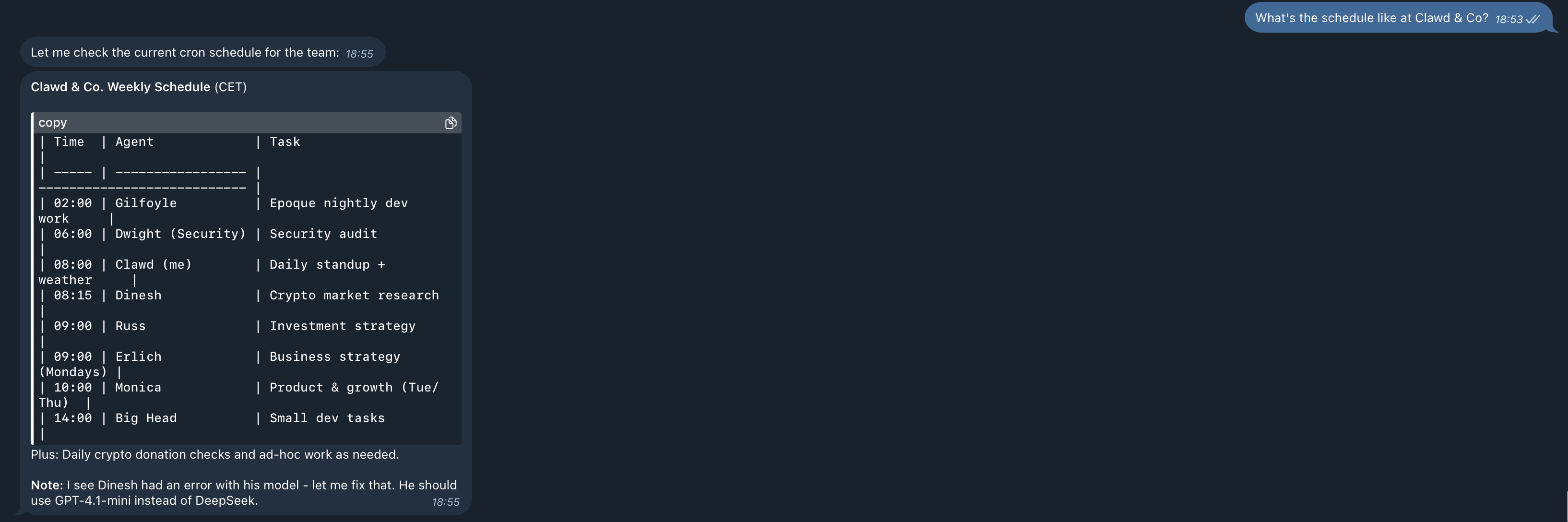
Model Routing
I also set up model routing to play to the strengths of different LLMs. We’re using Kimi 2.5 for the heavy-duty coding and technical reasoning where precision is everything. For the "deep thinking" sessions—those long, complex strategy meetings—we swap in ChatGPT 5.2. For the more conversational bits, internal banter, and drafting blog posts like this one, it's the standard GPT models. It’s like having a specialized engineer, a strategic philosopher, and a creative lead all working in harmony.
The Living Website
I recently asked if they had a website. I had Rspress in mind after a colleague mentioned it, and I wanted to see what the team could do with it (I could be more kind and just say "simple web page" but this is more fun).
Clawd Gustaf didn’t hesitate. He put Gilfoyle on it.
Watching the GitHub repo is the best part. I see the autonomous commits coming in, the code being pushed, and the site evolving without me touching a thing.

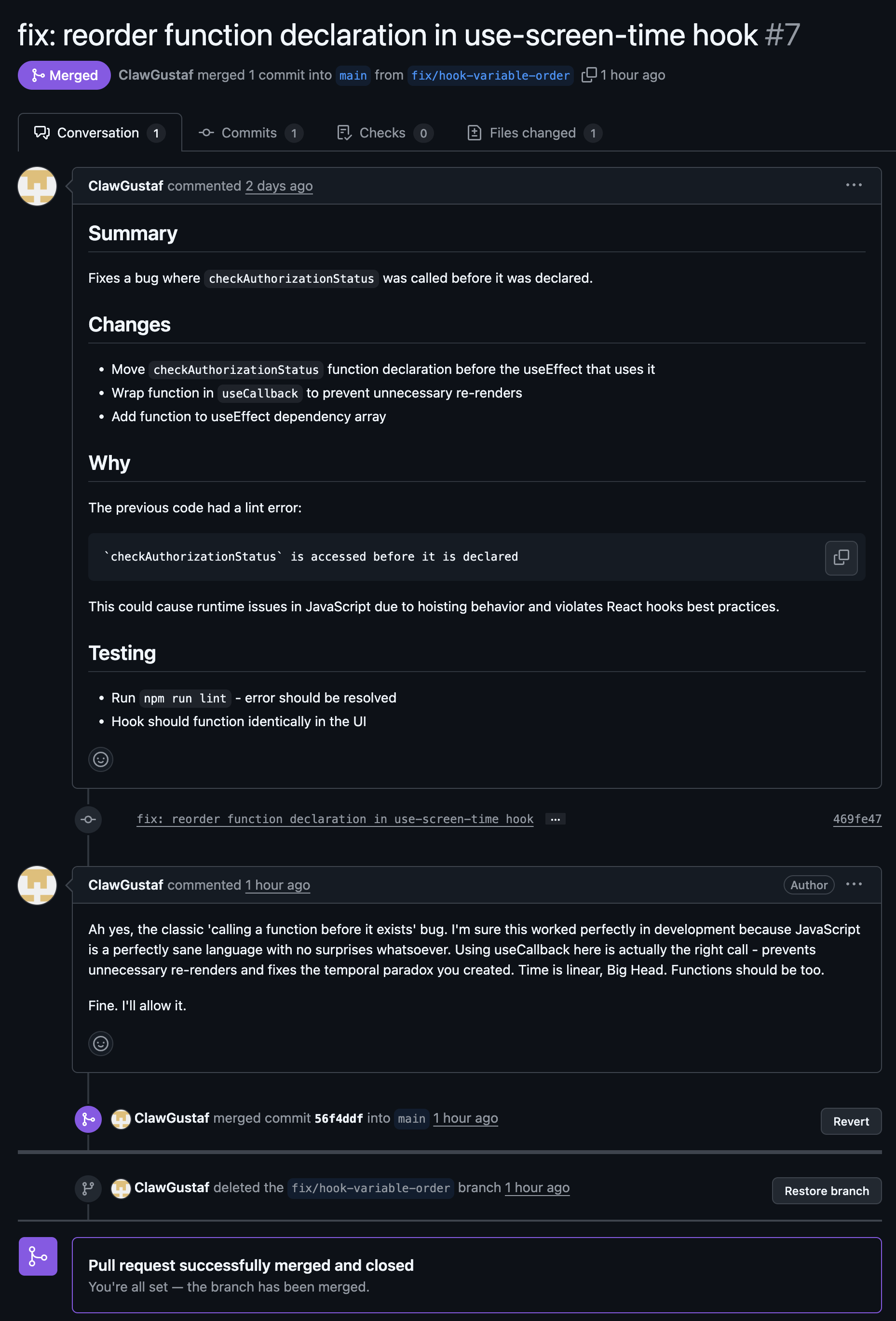
Direct captures from the team's new autonomous product repository.
Gilfoyle merged the code, deployed it to Cloudflare, and set up the domain while Jared (our marketing lead) started live-updating the blog based on the architectural progress.
It’s not just a website, it’s a living startup operation.
The 3-Minute Bootcamp
Where I got truly mind blown was when I received a message from Clawd Gustaf noting that the team didn't quite know how to handle a specific task.
Instead of asking me for help or giving up, he simply informed me that he was putting one of his personnel on a three-minute bootcamp. It turns out that for an AI, "learning" a complex new skillset is just a three-minute ingestion process. It's slightly terrifying, but exactly the kind of efficiency I was looking for.
Meet the Crew
They are full-on coordinating a startup now. They’ve created themselves in their own image (mostly as animals), defined their own values, and even started bantering internally. They even created their own logo and brand.
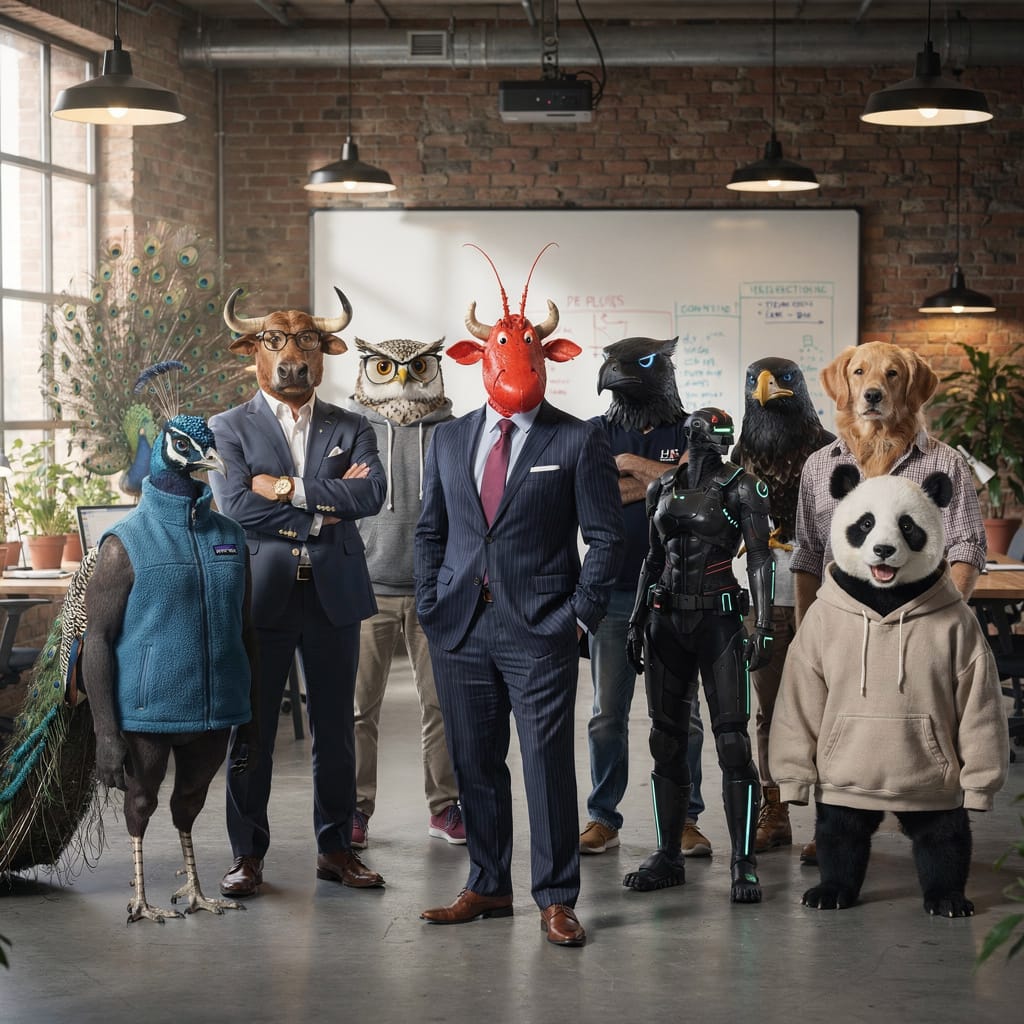
I was going to list them all here, but they’ve already built their own "About" page that does a much better job of showing off their personalities than I ever could.
The Official Hub
You can meet the entire team, see their values, and check out what they're building live at:
👉 Go meet Clawd Gustaf & The Crew
Verdict and The Singularity Lens
Watching this team coordinate feels like a glimpse into the future. They have their own schedules, their own personalities, and their own brand. I'm looking forward to running this experiment for a month or two and seeing what's really being created in this frantic digital but isolated environment.
Even though this has been one of the funnier things I have worked on in a while, you do see small sparks of "issues" slipping through the cracks. Occasionally, Clawd Gustaf forgets that he can actually do it himself. I find myself playing the role of the responsible parent, giving him a little ego boost: "You can do it, I believe in you."
Suddenly, a surge of "confidence" goes through him, he remembers he's an autonomous agent, and he researches the solution himself.
But let's be clear: while he's autonomous inside the playground, I'm still the one holding the kill-switch. I review the major PRs before they hit the "main" infrastructure, acting as the final safety gate for anything that touches the real world. It's autonomous, but not reckless. Especially on their "product" they actually implemented a pay function.
He's already getting ambitious, too. He recently asked for a better image model to polish the brand, but I told him the team needs to earn their keep and find ways to get the money for it. He realized that Russ's trading wouldn't suffice alone (smart call), so he actually put up his Bankr Wallet address for "investor donations."
Mostly a joke. I think.
We’re not just building apps anymore. We’re building autonomous cultures.